
TERRANCE FRANK LAZAROFF, CD, BFA
My Articles.
|
The Sanbao Experience By Terrance Frank Lazaroff, CD BFA The small van carrying me from the airport
arrived at Sanbao, just before the evening meal. Stepping out of
the vehicle and looking around, my inner thoughts told me that I
was about to experience an adventure unlike any other that I had
known. This would have a profound effect upon my life and art, as
well as my interpretation of Chinese ceramics, the Chinese people
and their culture. The walled residency compound, rich with
the rust colored adobe surfaced walls welcomed me. Red banners
hung vertically on each side of the entrance, displaying large
calligraphic characters, wishing prosperity and long life to all
who entered. Paper lanterns suspended like giant crimson cherries,
swayed lightly in the breeze. We crossed the threshold and entered
an inner courtyard that was a beautiful garden of subtropical
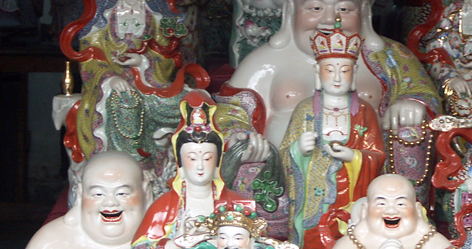
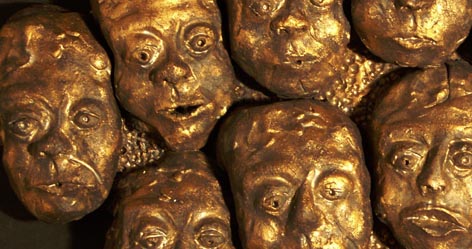
fauna and delicate flowers. A gaggle of ceramic, Chinese
mythological characters and heroes, partially hidden amongst the
thick foliage stared at us as we passed by. A narrow wooden
footbridge carried us across a small tributary to the entrance of
the inner court. After climbing a few steps of hewn stone, past
numerous clay pots, bowls and piles of fused Ming and Qing shards.
The cackle of a few chickens as they went running by, greeted us.
There was a small band of puppies, a delicious smell of food
cooking and the soft banter of other artists partaking of their
evening meal. We had arrived, and my education was about to begin. The Sanbao Ceramic Art Institute, founded
by the international ceramic artist Jackson Li, is quietly nestled
on the banks of a small river that meanders down through a lush
green valley, surrounded by steep, densely treed mountains and
rolling foothills. The valley is a quilt of waving rice fields and
vegetable gardens. Jackson Li founded the institute about five
years ago. It has since grown to international stature, promoting
a clay art exchange throughout the world. The residency program
offers visiting artists and residents full clay studio facilities,
sumptuous meals and most comfortable accommodations. Sanbao is
truly a “Club Med” for ceramists and potters. Sanbao was also to become my gateway to the
city of Jingdezhen, noted for the famous blue and white porcelain
ware that was a key trade item on the Silk Road and during the
time of the wind filled sails with foreign clipper ships. The
staff of Sanbao was to become my mentors. They encouraged me to
discover the local and distant landmarks. They invited me to delve
into the mysterious Chinese cultural activities, to appreciate
their music, and experience the generous hospitality of the local
residents. I established myself quickly and soon
followed the small road to Jingdezhen. Although some of the
resident artists preferred to purchase bikes or use foot power to
travel back and forth to Jingdezhen, I found the best way to
travel about was by taxi. This mode of transportation was an
experience in itself. Jingdezhen is a small city. The guidebook
Lonely Planet lists the population at about a million, four
hundred thousand strong. The city lies on the banks of the Chang
Yang River near Gaoling; a small village that was rich in supplies
of the kaolin clay which is a crucial ingredient of porcelain. The
Chang Yang River was the conduit to the sea that allowed the blue
and white porcelain to reach all parts of the world. I found Jingdezhen to be a bustling center
of activity, dominated by the ceramic industry. Some inhabitants
say that one third of the city of Jingdezhen creates porcelain
objects. One third supplies the logistics and the remaining third
provide the support infrastructure, such as families, schools,
government agencies, local merchants and professional services. The city was at one time listed as the most
polluted city in the world. That was because it used coal and wood
as its primary energy source to fire the hundreds of kilns
required to convert the clay to the “white jade” porcelain. Today
the story is different. Nearly all of the coal-fired kilns have
closed down leaving only tall chimneys as monuments of the past.
More efficient, natural gas kilns have since replaced them. The
strong smell of sulfur, in the air, has all but disappeared. I found that I could stand on any street
corner in Jingdezhen, and I would see something connected with the
ceramic industry. The Jingdezhen Ceramic Institute points out that
there are seventy-two steps required to make a porcelain product.
One person will be responsible for one task. They are highly
focused, expertly trained and extremely dedicated to producing a
quality product. They become masters at their chosen activity. The city was like a large factory without a
roof. It was not uncommon to see ceramic ware, at all stages of
completion, being transported throughout the streets and alleys of
the town. Ceramic objects would move from studio to studio,
factory to factory. Each move was to complete the next step in the
process. There were the throwers, trimmers, glazers, decorators,
kiln masters, transportation jobbers, wrappers and shippers. The
ceramic object would be sold and delivered to the customer thus
ending the process. I walked about Jingdezhen amazed at what I
saw. There were factories making large-scale vases, some fourteen
feet high. I saw teams of young artists moving about forests of
pots, some composing landscapes, others drawing dragons. I saw a
man walking down the street, carrying a large pug of clay on his
shoulders. He turned up a narrow alley, and I followed. He led me
through a narrow walkway, between two buildings, into the small
courtyard of a clay studio. There a group of artists were creating
large ceramic tiles, four foot by four foot, sculpted, in
bas-relief. Another day would find me wandering through
the antique market looking for treasure. The antiques on sale,
however, were probably made the day before. Nevertheless, they are
at times considered being of superior quality than the originals.
Another day found me exploring the back alleys of the city and
finding an abundance of slip-ware studios. Thousands of green-ware
forms, both contemporary and traditional, were basking in the sun,
waiting for a customer. Hardly a day passed without a discovery. Yes, Jingdezhen is a Mecca for ceramic
artists, ceramic lovers and anyone interested in visiting China.
Did I have time to create a body of work during my two-month stay
at Sanbao? Yes, I did some artwork, but not as much as I would
have wished. There was so much to see, so much to learn and so
much to experience. My adventures became the start of an education
that will continue for the rest of my life. |
ABOUT Terrance
 I have
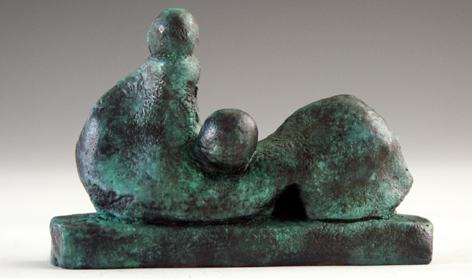
recently started to enjoy making sculpture. My latest project is working with
the Serge Bourassa bronze foundry located at St-Robert, Quebec; just out side
of Sorel. I am awaiting my latest series of bronze pieces.
I have
recently started to enjoy making sculpture. My latest project is working with
the Serge Bourassa bronze foundry located at St-Robert, Quebec; just out side
of Sorel. I am awaiting my latest series of bronze pieces.
The major difficulty working with bronze sculptures is finding a place in the studio where one can use wax and plaster without contaminating the workspace for clay art..
MORE INFORMATION ABOUT TERRANCE
The military required individuals to participate in community activities and this training carried over into my new civilian activities. I believe that one must participate in order to make change. More information about my affiliations is available.
TMy experience in China has given me the opportuntiy to speak in public about life and craft in China. I have also published three journals for 1001POTS. I presently write a blog and I do dabble in poems and fiction short stories. More information about this side of my life is available.